
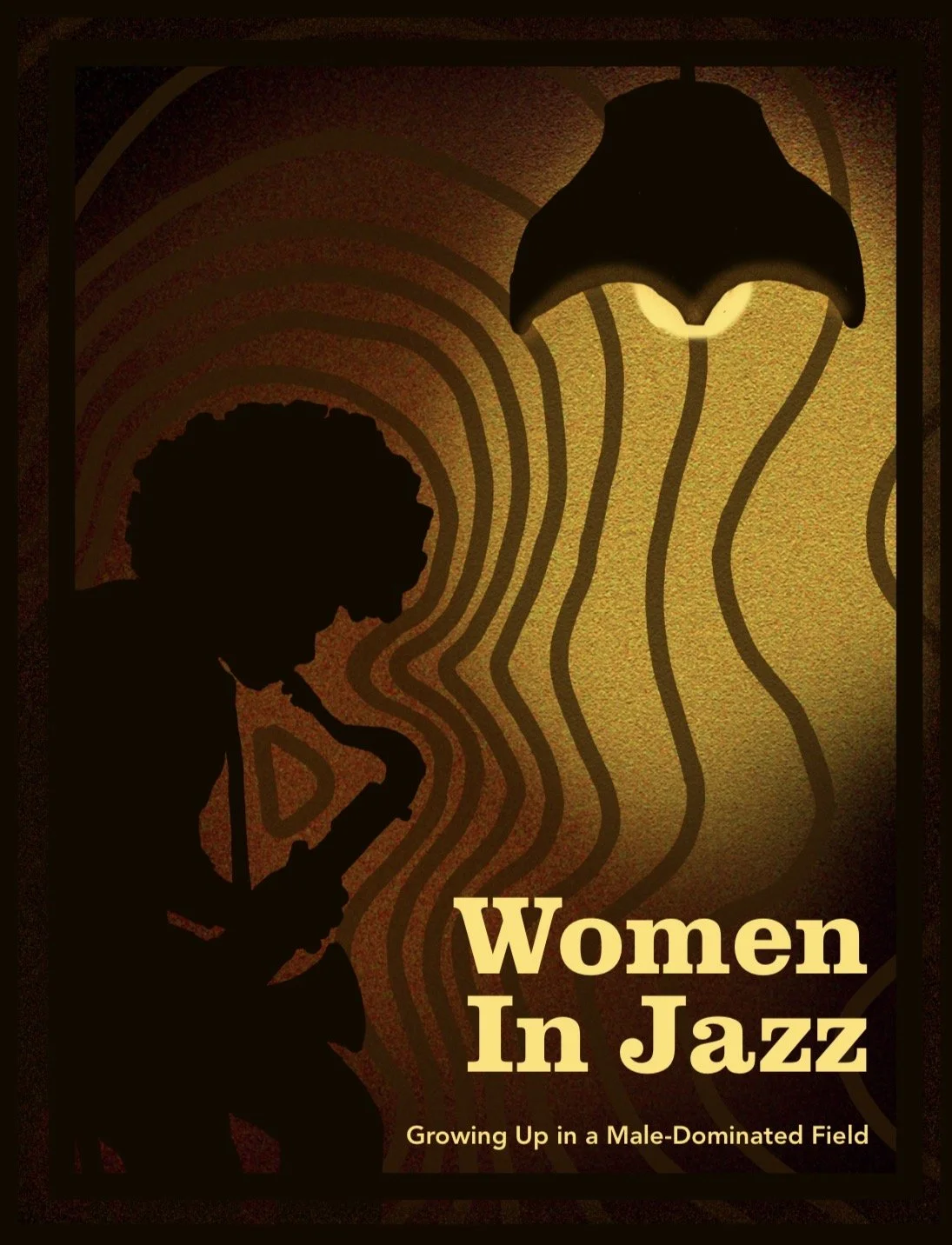
Women In Jazz: Growing Up in a Male-Dominated Field
Writer: Madilyn Dalton
Graphic Designer: Layla Shockley
When I first started playing bass, I never thought of my instrument as a “boy” or “masculine” instrument. I was fortunate to grow up in an environment that didn’t think this way, whether it be my family or school. However, as I grew up through junior high and high school and branched out, I found that not everyone was as open-minded. I first started to learn this idea around eighth grade. It started out more subtly when I tried to find YouTube tutorials on how to play my favorite songs, and I began to notice that none of the creators were women. As I learned about jazz history, it was difficult to look past the fact that there were few to no prominent female role models in the jazz world other than singers, past or present. Additionally, once my junior high band started travelling to jazz festivals, there was not one judge who didn’t act surprised when they found out that my band had a female bassist. These instances were a catalyst for the way I started to view my instrument.
As I transitioned into high school, I was eligible to audition for the all-district and all-state bands. There were several occasions when I would be sitting next to people as they discussed who they thought would get the bass spot, even though I had held it for years. As if that wasn’t enough, I’ve also had times where a guy will try to give me audition advice and try to tell me what to play, even though I beat him the year prior and got all-state honors for the jazz bass. Furthermore, when my high school band would go to jazz festivals, there was one festival in particular that stuck with me: the judges spent a significant amount of time talking about how the bass amp and I were in completely wrong spots and that it was impossible to hear me (as you could hear the bass in their commentary tapes) but said nothing when the guy bassist from our Junior Varsity jazz band had the amp in the exact same set-up. These experiences made me question why I was being treated differently from my male counterparts. I’d be lying if I said it didn’t motivate me to work harder, be better, and defy everyone’s predetermined expectations of me, but these preconceived notions started having an effect on me; did I really belong in this space? Was there even a place for me? I have been told before that my appearance doesn’t match my playing. What does a bass player look like? For me, there was no community available to have these conversations with; other women dedicated to jazz were few and far between in my geographical area, leading me to miss out on opportunities to grow and connect through these experiences. Of course, I had some guy friends who would listen to my frustrations, but you can always tell they would never quite fully understand.
This didn’t change as I went to college this year. Although it's only been a couple of months since I arrived at college, I’ve already experienced situations similar to those I had in high school. At one of my recent university performances, an older couple approached me and said, “Not only do you have a beautiful face and body, but you also play beautifully!” Aside from the fact that what they said is slightly off-putting and a little creepy, they put so much value in my appearance over my playing, as they made it a point to make a comment on my appearance before what I played on the stage. Not even a week after that incident, I was playing a set at the university’s weekly jazz jam when someone pointed and said, “The instrument is larger than the player!” This interaction was ridiculous for two reasons: first, the upright bass is supposed to be taller than the player, as it has a mechanism that allows it to be lowered or raised to match the player’s height; second, I’m not sure why he felt the need to comment on my appearance. He noticed that I was obviously not humored, and told me, “But your playing sounds great!” in an effort to try to make it up to me. As with the old couple, he heard what he saw; he watched rather than listened, which is at the heart of the issue of women being underrepresented in jazz.
Women have historically been underrepresented in music, especially in jazz. I was fortunate to have the opportunity to sit down with the phenomenal jazz drummer and leader of the DIVA Jazz Orchestra (an all-female jazz big band), Dr. Sherrie Maricle, to discuss her experience with jazz and playing a male-dominated instrument. When talking about her beginnings with music, she said, “When I was a kid, I wanted to play the trumpet. When I was in fourth grade, I was told girls couldn’t play the trumpet.” Being told as a fourth grader that she couldn’t play an instrument because of her gender was astounding to her. After being asked to elaborate on how she felt at that moment, she said, “I really thought to myself, ‘Well, this band director is a complete idiot.’ Like, what a jerk. How does an instrument have a gender? Instruments don’t have genders.”
Dr. Maricle isn’t the first woman to fall victim to these stereotypes; the idea of “what women should play” has been prevalent in music for centuries. Ancient Greek artwork depicts men and women playing certain instruments to show varying levels of masculinity or power. There is also the tradition in some religions where women must be the primary caretaker for the family and home, a traditionally "non-masculine" task. However, the gender stereotypes of our current age were popularized when Coventry Patmore’s poem, “The Angel in the House,” was published in 1854. The poem created the image of a wife who is obedient, content, and unchallenging of her husband's wishes; it became immensely popular. Combined with millennia of previous sexism, its stereotypes crept their way into all facets of life. Music (within that: jazz) is not an exception.
In the 1930s and 1940s, during the peak of blues and swing music, it would seem that these sexist beliefs had no discernible impact on music or jazz. Bessie Smith was the highest-earning entertainer and most popular blues singer of those years. Ma Rainey, Mamie Smith, and Billie Holiday were in very similar standings to Bessie Smith as well. However, those women were singers, and to the men in charge of their bands, labels, and careers, that’s the only way they would be allowed to be represented in the industry. Women, if they were going to be involved with music at all, were expected to sing. This expectation has persisted over the years, as Dr. Maricle’s former band director demonstrated: playing a “masculine” instrument would not be allowed. Although this notion is not as strong in modern times, it remains prevalent, as women are still heavily critiqued when playing a male-dominated instrument in a male-dominated genre.
During her interview, Dr. Maricle made many great, insightful points, and what really stood out to me from her words were her facts about how the music industry today treats women performers and how we can combat the current state of the jazz industry. Throughout her years as a performer, she’s found that the attitude toward women is often, “Oh, you’re here because you deserve it and you play your butt off.” It’s like, wow!, you must be here because you’re a gimmick and you’re a woman!” She has experienced this many times, whether it was a stage manager telling her that the client doesn’t want a “chick” playing or her requesting to get female players and being told that “women don’t play those instruments.” She also mentioned that when men make mistakes in music, the accidents tend to be seen as what they are: mistakes. However, when women make a mistake, it feels like a “gotcha” moment, where you’re exposed for being a fraud.
This environment can be highly discouraging for young musicians at the early stages of their musical development, such as myself. The root cause of this issue isn’t necessarily that there aren’t enough women musicians (although, as of 2021, only 27% of the people involved with jazz music are women, most of whom are singers), but that women aren’t getting called to play or even making it on the audition list. This is rooted, as addressed before, in the fact that the consumers and entertainers are having a hard time disconnecting the image from the sound; we’re so focused on the story that we make up in our heads about the performer instead of seeing the person with our ears and taking their music and talent for what it is. This isn’t a secret: many more spaces have adopted blind auditions as a common practice, but there are still many barriers and circumstances that discourage women from advancing further in their music careers.
Dr. Maricle makes it a point that not everybody thinks that female musicians, especially on male-dominated instruments, are out of place, and that the younger generation is much more evolved, but that there is still so much more room for us to grow. The bias around women in jazz isn’t something that’s inherent: it’s something that is taught, whether through subtle notions in our community or through certain news sources. There are many ways we can change the way we view women performers. One of the most significant ways, although very plain, is simply to be part of the conversation; being a part of the conversation makes a huge difference in breaking the stigma surrounding female jazz players. This isn’t just a conversation woman-to-woman; this is a conversation for everyone. As Dr. Sherrie Maricle says, we should always be supportive of each other because the whole point of music is to make it great together as a community, or as she neatly puts it, “the sum is greater than the parts.” When we feel threatened by other people on the stage, we lose everything that the music can be. Ultimately, organized music is something unique to us as a human species, and we have so much to do to foster an environment where every talented musician, regardless of gender or instrument choice, can be justly recognized for their hard work and dedication to keeping the genre alive.
Some Female Jazz Artists to Start Looking into and Supporting:
Ingrid Jenson (trumpet)
Sherrie Maricle (drums and percussion)
Esperanza Spalding (bass)
Sarah Hanahan (alto saxophone)
Erena Terakubo (saxophone)
Mohini Dey (bass)
Hiromi Uehara (piano)
Artemis (small combo group)
Jackie Warren (piano)
Noriko Ueda (bass)
Liesel Whitaker (trumpet)
Gunhild Carling (trombone)
Sheila E. (drums and percussion)